Svetlana’s Dance, Tom Pow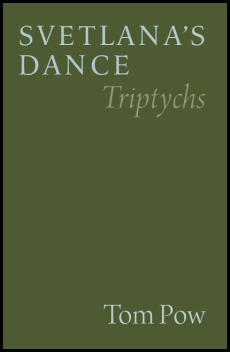
Mariscat Press, 2022 £7.50
Telling tales
Tom Pow’s Svetlana’s Dance takes a pointillist approach to storytelling. The pamphlet is made up of two sets of nine poems, the first nine more or less inspired by medieval religious autobiographies and iconography, the second focussing on more modern events, often tragedies, and touching everything from Stalin’s daughter, Svetlana, to the Grenfell fire.
Gathering all these stories together in one place gives the feeling of one of those northern European medieval paintings — full of life, and the life on display full of suffering, suffering here being something commonplace, almost expected. The effect is often macabre. In ‘The rat-catcher’, the central figure — who is ‘half man, half rat’ (‘One has formed on his / shoulder like a tumour’)— is particularly memorable.
I was interested in the way these stories were told, too. The language is simple: often the poems read like the folk tales on which many of them are based, cut up. Coming across that familiar, fairy-tale voice in a poem is simultaneously nostalgic, and unsettling:
Whenever anyone tried
to pull the knot out, great pain
tormented the girl.
Having three sections to each poem also allows Pow to move easily between different moments — and play with the spaces between them.
‘Blown’, for instance, is a story about a man whose father and uncle would collect birds’ eggs on the cliffs of Dover. In the first and second sections, the narrative is second-hand, the narrator perhaps reporting a story they heard a while ago:
It was tricky work and both hands
were needed each way. They wore
peaked caps capacious enough
to hold the eggs they picked from ledge
to ledge. Climbing down, they felt them
roll lightly over their scalps
or bounce gently just above
their brows
In the third section, however, the storyteller becomes part of the story. Time is suddenly condensed:
He tells me that his uncle —
many years after he’d been
a ten year old egg collector —
would be killed as Allied Forces
fought their way up Italy.
A sniper bullet — a clean shot
to the head. His nephew pauses;
an old man, reflecting on
the fragility of a skull.
With the speaker present, the previous sections become more personal. There’s a link drawn, too, between the nephew (now an old man) and his father and uncle as children: he is still a nephew, however ‘old’.
Then there's that final image of the skull — which is also, inevitably, an egg. And those eggs, too, riding in the boy's caps, they begin to look a little different. More like skulls.
Jeremy Wikeley
Triptychs
There are just too many points of interest in this excellent collection — its varied epigraphs, its juxtaposition of the medieval and the modern. But mostly I found myself thinking about how the form of a triptych is used to such interesting effect.
The publication is structured in three parts. Each poem consists of three sections. Each section consists of three three-line stanzas. But then there’s the middle part, ‘Threshold’, where the text is divided across two pages separated by white space. The poem makes clearest sense if read across the two pages, traversing the quietness at the centre. It’s like a triptych with a blank centre panel. Or, anticipating the Eliot epigraph, something:
heard, half-heard, in the stillness
Between two waves of the sea.
Many triptychs are altar-pieces and hence religious in subject and message. Often closed for most of the year, they were opened for viewing in all their glory on feast days. Is there a parallel here? The central part is clearly key, but has a halting, almost tentative quality. It is flanked by formal constructs of colourful narrative. The first part draws on early historical sources. The instructional tone of ‘Margery Kempe’s Marriage’ echoes the role of the altar-piece:
she’d rather
eat muck from the gutter
than refresh the delight
she and her husband once took
in each other’s flesh.
The second part is more modern in its settings, but there’s underlying violence, medieval in its barbarity. ‘The Forest’ uses the victim’s resignation to horrific effect:
‘We just chose the losing side,’
one said, as his sometime neighbour
slipped the rope over his head.
The side panels of an altar triptych are often hinged, and there are many doors in this pamphlet. The door on which a resident of Chernobyl laid out his father, the door as a raft for migrants and — in the central ‘Threshold’ — a partly open garden door. Beyond it, we glimpse the garden where ‘come feast day / she’ll be dazzled’. But in order to accept the ‘invitation / to a world / becoming’ we must navigate the quiet of the blank space.