Badlands, Hugo Williams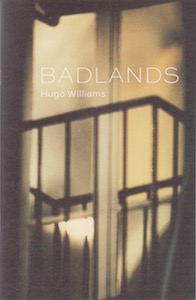
Mariscat Press, 2021 £7.50
It’s all in the title
In the title poem ‘Badlands’ two things are happening: a man is sitting on a train reading a book, Rendez-vous in El Paso, A Tale of the Old West. Meanwhile, that same man is also imagining the woman he’s going to meet as if she were a character in the story:
For a second I glimpse her animal self
rounding up wild horses
[…]
I’m hot on her trail,
[…]
refusing to look up from my book
till I enter the Badlands myself.
The poems in the first part are full of such references, conjuring up the wild sexual exploits of a man in the ‘badlands’ of a city. ‘Bite-marks’ begins:
Are women naked, do you think,
or is it impossible to say
[…]
Looking doesn’t help.
Looks leave only bite-marks
down the backs of knees
Is this ‘the male gaze’ galloping unrestricted to some sort of violent conclusion at a rendezvous — his own equivalent of El Paso in the book title?
No. It didn’t take long for me to realise that these are fantasies which somehow never quite materialise — not even in the mind of their protagonist. In ‘Sunset Hour’ a ‘carousel of hallucinations’ has been ‘left on by accident’:
and her,
perched on a late bar stool,
her hips and hair and shoulder blades
dawdling for a moment
[…]
till the projector jams
and the apparition goes up in smoke,
a silent burn-hole blossoming
where her mouth used to be.
We move through that ‘silent burn-hole’ into the poems on the other side. ‘Badlands’ in Wikipedia is said to be ‘a type of dry terrain where softer sedimentary rocks and clay-rich soils have been extensively eroded’. The later poems take on a more intimate and gently poignant tone: they’re dealing with a man’s struggle to come to terms with aging.
In ‘Night Starvation’ the ‘I’ makes a cup of Horlicks which remains as a dry powder floating on the surface. And the poem ‘Peace and Love’ ends with a night time prayer:
keep me busy counting chimney pots
while I seek an end to love.
Anne Bailey
Love in a time of lockdown
Love in its many forms dominates Badlands with an obsessive restless energy. ‘You can swim can’t you?’ Williams asks at the end of ‘The Plunge Club’ and, by the end of the pamphlet, I wasn’t so sure I could. The honesty with which he tells his stories left me scanning the horizon for the life-raft, exhilarated but exhausted. In the final poem, ‘The Story so Far’, there’s only an uneasy peace:
We climb into the fork
of the tallest tree
and kick the ladder away.
Badlands explores love in a series of exquisite, elegant fourteen-line poems — sonnets really, but like their author they aren’t bound by rules. ‘Whatever Love is’ captures the excitement of spontaneous love. I couldn’t help remembering the words of its title were used by Prince Charles in an interview before his marriage to Diana.
Then in ‘Bite Marks’ we witness lust ‘talking in moans’, while in ‘Some Hope’, the theme is obsessive love.
The love that consoles (but perhaps inhibits creativity) features in‘Ink Ink’:
she’s found a hole in my jacket,
do I want it mending?
And one even the Greeks hadn’t spotted is ‘Disco Love’, a ‘brief attempt at flight / defying gravity and depravity’.
The lockdown element is, I think, important right through the pamphlet. These are reflections and memories conceived in an isolation from which there’s no escape:
I’d willingly swagger the nut-strewn roads
if it meant escaping this peculiar
ruined afterlife we seem to have invented
but where else is there to go?
[‘Nowhere Man’]
The question, one feels, is literal and metaphorical. All roads lead back to our need for love and the relationship to another human being, with all its difficult, messy compulsions.
In ‘Life at Sea’, we see love for the fellow-sufferer. In this case it’s two strangers, bonding over a smoke. It has an Ancient Mariner feel to it. They can’t help but repeat their stories: ‘he’d heard it all before, he said / He likened it to seasickness.’
This may be the oldest subject, but Williams explores it with such panache that I was held as entranced as any wedding guest.
David Lukens